
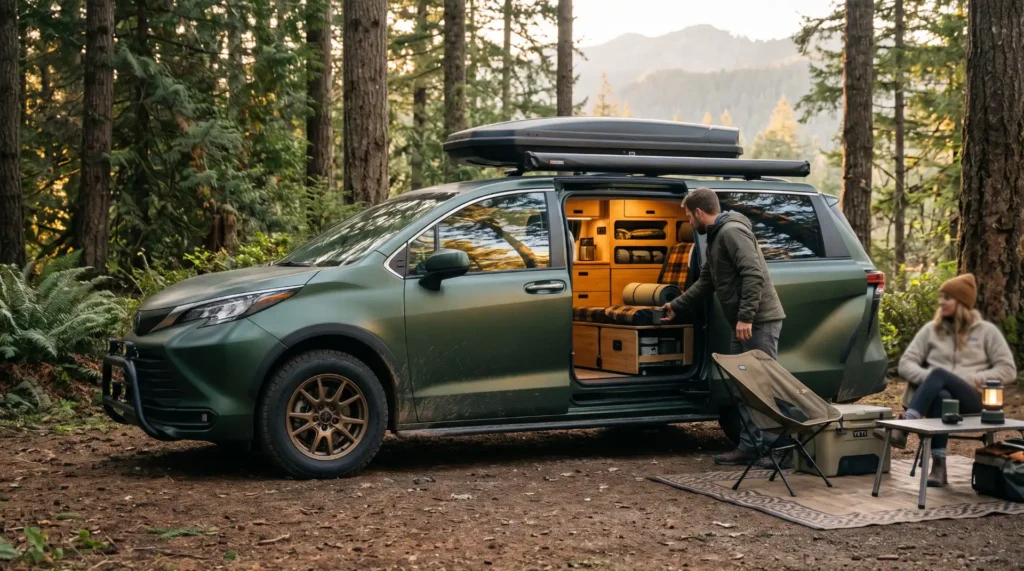
For decades, the American minivan occupied a familiar place in automotive culture. It was the vehicle associated with school drop-offs, grocery shopping, soccer practices, family vacations, and weekend errands. Its reputation was built around convenience rather than excitement. Sliding doors, three rows of seating, generous storage, and comfortable passenger accommodations made it one of the most practical vehicles available to American households.
However, a growing customization movement is challenging the traditional image of the family van. Owners are increasingly looking at minivans and passenger vans as platforms for personal expression, outdoor recreation, and practical adventure travel. Instead of purchasing a large recreational vehicle or replacing a family SUV with an expensive off-road truck, some drivers are transforming vehicles they already own into compact adventure machines.
The movement includes everything from relatively inexpensive sleeping platforms and removable storage systems to sophisticated suspension upgrades, custom wheels, rooftop equipment, auxiliary lighting, portable power stations, and professionally designed camper interiors. Some builds are intended for occasional weekend camping, while others support extended road trips, mountain biking, fishing, photography, and outdoor exploration.
This development is especially interesting because it brings together two automotive communities that have traditionally operated separately: minivan enthusiasts and adventure-vehicle builders. The result is a different approach to vehicle customization, one that places everyday usability alongside appearance, capability, and individuality.
The change is not simply about making a minivan look more aggressive. It is about rethinking how an ordinary family vehicle can support a more flexible lifestyle without losing the features that made it useful in the first place.
Recent manufacturer activity also suggests that the interest is becoming more visible. In August 2026, Chrysler introduced two customized Pacifica concepts, including a collaboration with the minivan enthusiast community VANkulture. The projects demonstrated how a conventional family vehicle could be transformed through distinctive styling, wheels, suspension modifications, and other enthusiast-focused upgrades.
That development offers an interesting glimpse into the future of American van customization. Families and enthusiasts no longer have to choose between a practical vehicle and one that reflects their interests. With thoughtful planning, an everyday minivan can become a personalized adventure vehicle while remaining useful for normal transportation.
1. Why American Families Are Looking at Minivans Differently
The renewed interest in minivan customization reflects a broader change in how some American households think about transportation. Vehicle ownership is increasingly connected to hobbies, travel preferences, outdoor activities, and personal lifestyle choices. A family vehicle does not necessarily have to remain limited to commuting and errands when its interior and exterior can be adapted to support other activities.
For years, SUVs dominated much of the conversation about family adventure vehicles. Their elevated driving position, available all-wheel drive, larger tires, and rugged exterior styling made them attractive to buyers who wanted something more adventurous than a traditional passenger car. However, SUVs also have limitations. Many three-row models sacrifice cargo capacity when all seats are occupied, while larger body-on-frame vehicles can be expensive to purchase and operate.
Minivans approach the problem differently. Their relatively low floors, wide sliding doors, flexible seating arrangements, and spacious cabins create opportunities for customization that are not always available in conventional SUVs. A family can transport children during the week, carry bicycles on Saturday, and use a removable sleeping platform for a weekend camping trip without necessarily owning multiple vehicles.
The Chrysler Pacifica, Honda Odyssey, Toyota Sienna, and Kia Carnival are examples of modern minivans that attract buyers looking for passenger comfort and adaptable interiors. Their configurations differ, so the right customization strategy depends on the specific vehicle, model year, trim level, and available equipment.
There is also an important cultural development behind the trend. Younger enthusiasts are increasingly comfortable treating practical vehicles as customization projects. They may appreciate an unusual wheel design, a lowered suspension setup, a distinctive wrap, or an intelligently organized interior just as much as traditional sports-car owners appreciate engine upgrades and aerodynamic components.
In August 2026, Chrysler showcased two customized Pacifica concepts at Roadkill Nights. One followed a relatively restrained factory-inspired approach, while the other was developed with VANkulture and featured more extensive enthusiast-oriented modifications. Chrysler also reported increased participation from younger minivan buyers and projected growth in U.S. retail minivan sales over the following five years. These figures are company-reported market expectations, rather than independently verified sales forecasts, but the concepts demonstrate that manufacturers are paying attention to minivan personalization. Chrysler’s announcement of the two Pacifica concepts provides a useful example of the direction in which this culture is moving.
The important point is that customization no longer has to mean turning a family vehicle into an impractical show car. A well-designed minivan can retain its original purpose while gaining a more distinctive appearance and additional recreational capabilities.
 2. The Difference Between Adventure Vans, Camper Vans, and Customized Minivans
Although these terms are sometimes used interchangeably, they describe different approaches to vehicle customization.
An adventure van is generally designed to support outdoor activities and travel. It may include upgraded tires, exterior storage, recovery equipment, auxiliary lighting, sleeping arrangements, and equipment for camping or recreational sports. It does not necessarily need a permanent kitchen, bathroom, or elaborate living area.
A camper van is more specifically designed to provide some of the conveniences associated with recreational vehicles. Depending on the conversion, it may include a fixed or convertible bed, cooking equipment, water storage, electrical systems, insulation, ventilation, and dedicated storage for extended trips.
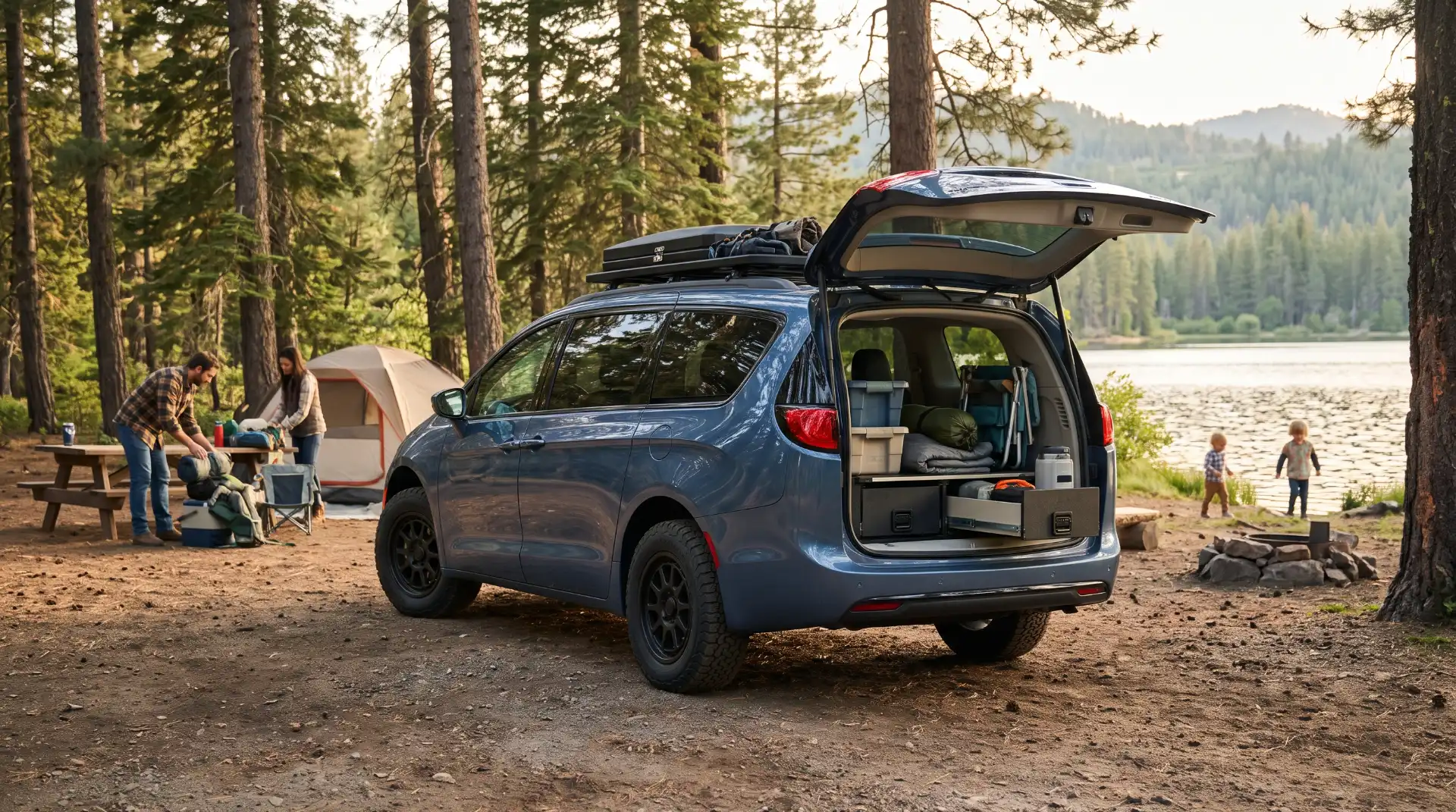
A customized minivan can occupy either category. Some owners make only exterior modifications, while others install removable camping equipment that can be taken out when the vehicle returns to normal family duties.
This distinction matters because a minivan has different dimensions and structural limitations from a full-size cargo van. A high-roof Ford Transit or Mercedes-Benz Sprinter can accommodate standing-height interiors and more extensive conversion systems. A typical passenger minivan cannot offer the same amount of interior volume.
However, that limitation can become part of the design philosophy. Instead of attempting to reproduce a large recreational vehicle in a smaller space, successful minivan builds concentrate on efficient storage, lightweight equipment, flexible sleeping arrangements, and easy conversion between different uses.
For a family that takes occasional camping trips, a removable platform and compact power system may be more useful than permanent cabinetry. For someone who travels frequently with bicycles or outdoor equipment, a carefully designed cargo arrangement may provide more value than a complicated sleeping conversion.
The best adventure build is therefore not necessarily the one with the most accessories. It is the one that fits the owner’s actual lifestyle.
3. Exterior Styling: Giving a Family Minivan an Adventure Identity
Exterior customization is often the first visible step in transforming a conventional minivan into an adventure vehicle.
The objective is to create a cohesive appearance without adding unnecessary weight or reducing everyday usability. Unlike a dedicated off-road truck, a minivan does not need an extreme collection of accessories to establish a recognizable outdoor identity.
Adventure-Inspired Wheels and Tires
Wheels and tires can dramatically change the appearance of a minivan. Many factory minivans use relatively conventional wheel designs intended to balance comfort, efficiency, and everyday driving.
An owner might consider a more distinctive wheel finish, a rugged-looking spoke pattern, or an alternative wheel design that complements the vehicle’s paint color. Dark metallic, bronze, graphite, and satin-finished wheels are popular visual directions across the broader customization market.
Tire selection requires more careful consideration. A tire that looks aggressive may not provide the best performance for a vehicle that spends most of its time on highways.
Before purchasing alternative wheels or tires, owners should verify the correct load rating, tire dimensions, wheel offset, clearance, and compatibility with the manufacturer’s specifications. Changes can affect steering behavior, braking performance, speedometer accuracy, ride comfort, and fuel economy.
An adventure-oriented appearance should never come at the expense of reliable transportation.
Rooftop Cargo Systems
Rooftop storage is another popular feature of adventure vehicles. Families traveling with camping equipment, folding chairs, sports accessories, and luggage may appreciate the additional capacity.
A roof-mounted cargo box provides enclosed storage and can help protect equipment from rain and road debris. A roof basket offers a different appearance and can accommodate certain bulky items, although its contents require appropriate weather protection and secure fastening.
However, owners should not assume that a minivan can carry the same rooftop load as a large cargo van. Every vehicle has a specified roof-load limit, and the weight of the rack itself must be included when calculating the total load.
A rooftop system also increases overall vehicle height. Drivers must account for parking garages, drive-through structures, low branches, and other clearance restrictions.
Protective Exterior Accessories
Adventure vehicles often travel on gravel roads, forest routes, and rough campground entrances. Protective accessories can help reduce cosmetic damage in appropriate applications.
Depending on the vehicle, owners may consider splash guards, durable exterior trim protection, paint protection film, and protective coatings. These modifications can help preserve the finish from road debris and environmental exposure.
The goal is not to make a minivan look like a military vehicle. It is to create a practical exterior that can handle more varied environments while maintaining an attractive appearance.
Custom Wraps and Distinctive Color Schemes
A custom wrap can be one of the most effective ways to give a minivan a completely different personality.
Some owners prefer subtle earth tones inspired by national parks, forests, deserts, and outdoor equipment. Others choose bold contrasting graphics, motorsport-inspired stripes, or original illustrations.
A well-designed wrap can make an otherwise ordinary minivan look like a professionally developed adventure vehicle. It also provides an opportunity to connect exterior styling with the owner’s interests.
For Cars-Art.com, this creates an interesting connection between functional vehicle customization and automotive art. A family minivan can become a moving canvas without requiring extensive mechanical modifications.
The strongest designs usually follow a consistent visual direction. For example, a dark green vehicle with bronze wheels, restrained mountain-inspired graphics, and black exterior accessories can create a more cohesive appearance than a collection of unrelated colors and aftermarket parts.
4. Interior Conversions: Making Space Work for Family Adventures
The interior is where minivan customization becomes especially interesting.
Unlike exterior styling, interior modifications can directly change how the vehicle functions. A well-planned conversion can make a family minivan more useful for camping, road trips, photography, fishing, and recreational sports.
However, the original seating arrangement should remain a central consideration.
Families with young children may need all available seating positions. Other owners may regularly transport only two or three passengers and can dedicate more interior space to storage.
The correct design depends on the number of occupants and the activities the vehicle needs to support.
Removable Sleeping Platforms
One of the most practical modifications is a removable sleeping platform.
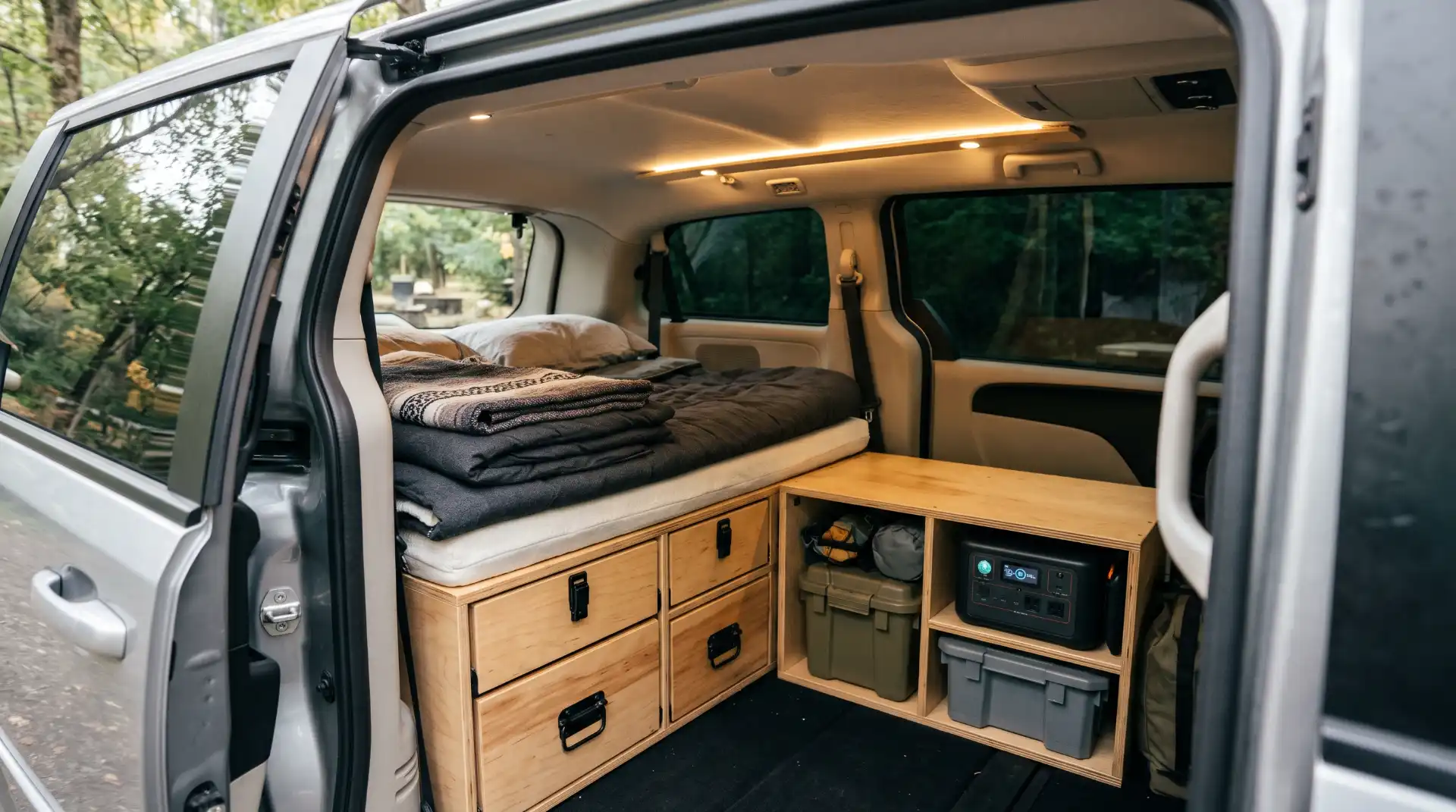
A platform can be designed to fit within the rear cargo area when selected seats are folded or removed in accordance with the vehicle manufacturer’s instructions. Some systems use lightweight plywood, aluminum framing, or modular panels to create a flat sleeping surface.
The platform should be designed specifically for the vehicle’s interior dimensions. It must remain stable during use and should not obstruct essential equipment, seat belts, airbags, or vehicle controls.
A folding or sectional design can make the system easier to store when it is not needed.
For example, a family could use the minivan normally during the week and install the sleeping platform before a weekend camping trip. When the trip is finished, the platform can be removed and the vehicle returned to its original configuration.
This approach is particularly attractive because it avoids turning a daily family vehicle into a permanent camper.
Modular Storage Drawers
Storage organization is essential in a compact adventure build.
Without a clear system, camping equipment, clothing, food, tools, and personal belongings can quickly occupy every available space.
Modular drawers provide a way to organize frequently used equipment. A lower storage compartment could hold recovery accessories, emergency supplies, or cooking equipment, while smaller containers could organize personal items.
The most effective systems make important equipment easy to reach without requiring the entire vehicle to be unloaded.
Families should also consider the weight of storage units and their contents. Heavy drawers, tools, water containers, and other objects can become dangerous projectiles during sudden braking or a collision if they are not properly secured.
Compact Cooking Stations
A minivan does not need a permanent kitchen to support outdoor cooking.
Portable cooking equipment, compact tables, insulated food containers, and removable storage modules can provide a practical alternative.
A removable cooking station can be stored in the cargo area and used outside the vehicle at an appropriate campsite. This avoids permanently sacrificing interior seating or installing unnecessary plumbing.
Cooking outdoors also helps reduce the risk associated with using combustion appliances inside an enclosed vehicle.
Families should follow the equipment manufacturer’s instructions and campsite fire regulations. Cooking devices that produce carbon monoxide must never be operated inside an enclosed passenger cabin.
Better Lighting and Interior Organization
Interior lighting can make a customized minivan feel more comfortable during nighttime camping and road trips.
Battery-powered LED lights, portable lanterns, and carefully selected low-voltage lighting systems can illuminate storage compartments and sleeping areas.
However, permanent electrical installations should be planned properly. Wiring should be protected from abrasion, moisture, excessive heat, and accidental damage.
Interior organization also benefits from simple details such as folding organizers, seatback storage, removable containers, and dedicated compartments for electronics.
The objective is to create a cabin where every item has a place. Good organization makes a small vehicle feel considerably more spacious.
5. The Rise of Modular Adventure Builds
One of the most interesting directions in modern van customization is modularity.
Traditional camper conversions often involve permanent cabinetry, fixed sleeping areas, built-in electrical equipment, and extensive interior alterations. These systems can work extremely well for dedicated travel vehicles, but they may be less convenient for families that depend on their minivans every day.
Modular customization offers another approach.
Instead of permanently converting the entire vehicle, owners install equipment that can be removed, repositioned, folded, or replaced depending on the trip.
A modular minivan could include:
-
A removable sleeping platform.
-
Stackable storage containers.
-
Portable power equipment.
-
A detachable camping table.
-
Removable window shades.
-
Compact cooking equipment.
-
Portable lighting.
-
Bicycle and sports-equipment storage.
The biggest advantage is flexibility.
A family could use the same vehicle for commuting, grocery shopping, school transportation, and weekend recreation without maintaining separate vehicles for every activity.
Modular equipment can also make upgrades easier. An owner might begin with a basic sleeping arrangement and later add a more advanced power system or specialized storage.
This gradual approach can reduce the pressure to complete an expensive conversion immediately.
Why Lightweight Materials Matter
Weight is one of the most important engineering considerations in a minivan conversion.
Every permanent modification adds weight to the vehicle. This includes cabinetry, flooring, batteries, water containers, roof racks, tools, passengers, luggage, and accessories.
A heavy conversion can reduce available payload, affect braking and handling, increase tire wear, and place additional demands on the suspension.
Lightweight plywood, suitable aluminum components, composite panels, and carefully selected storage materials can help control the total weight.
However, lightweight construction should not mean weak construction. Components must be strong enough for their intended use and properly secured.
A beautiful storage system is not a successful modification if it becomes unstable during an emergency maneuver.
6. Electrical Upgrades and Portable Power for Modern Adventure Vans
Electrical systems have become an important part of the adventure-vehicle conversation.
Families traveling for extended periods may want to charge phones, cameras, tablets, laptops, portable refrigerators, and other equipment without relying exclusively on the vehicle’s starter battery.
Fortunately, a compact minivan conversion can often benefit from portable power equipment rather than an elaborate permanent electrical installation.
Portable Power Stations
A portable power station can provide electricity for selected camping equipment.
These products generally combine a rechargeable battery, charging inputs, and several output connections. Depending on the model, they may support USB devices, small appliances, and other electronics.
Before purchasing one, owners should calculate their expected power requirements.
A smartphone charger consumes relatively little electricity, while a refrigerator or electric cooking appliance can require substantially more.
Battery capacity, inverter output, charging time, temperature limitations, and operating efficiency all matter.
A power station should also be stored and operated according to the manufacturer’s instructions, particularly when it is exposed to extreme temperatures.
Solar Charging
Portable solar panels can provide an additional charging option during outdoor trips.
A folding solar panel may be easier to transport and deploy than a permanent rooftop installation. It can be positioned in sunlight while the vehicle remains parked.
Solar performance depends on weather, season, panel orientation, shading, and available sunlight.
For families who primarily visit established campgrounds, a portable battery system that can also be charged from an appropriate electrical outlet may be more practical than a complicated solar conversion.
Avoiding Electrical Problems
Permanent electrical modifications should be performed by qualified professionals when they involve complex wiring, battery integration, charging systems, or connections to the vehicle’s electrical network.
Poorly installed wiring can create fire risks, battery damage, and electrical failures.
Owners should avoid treating a vehicle’s original electrical system as an unlimited power source. An auxiliary battery or portable power station should be selected according to the equipment it needs to support.
The best electrical setup is the simplest system that reliably meets the family’s actual requirements.
7. Suspension, Ground Clearance, and the Limits of Minivan Off-Road Capability
The visual transformation of an adventure minivan can make it appear ready for difficult trails, but appearance and mechanical capability are not the same thing.
Most passenger minivans are designed primarily for paved roads, urban transportation, and ordinary weather conditions. Some models offer all-wheel drive, but that does not automatically make them equivalent to purpose-built off-road vehicles.
Owners should understand these limitations before investing in suspension modifications.
Suspension Upgrades
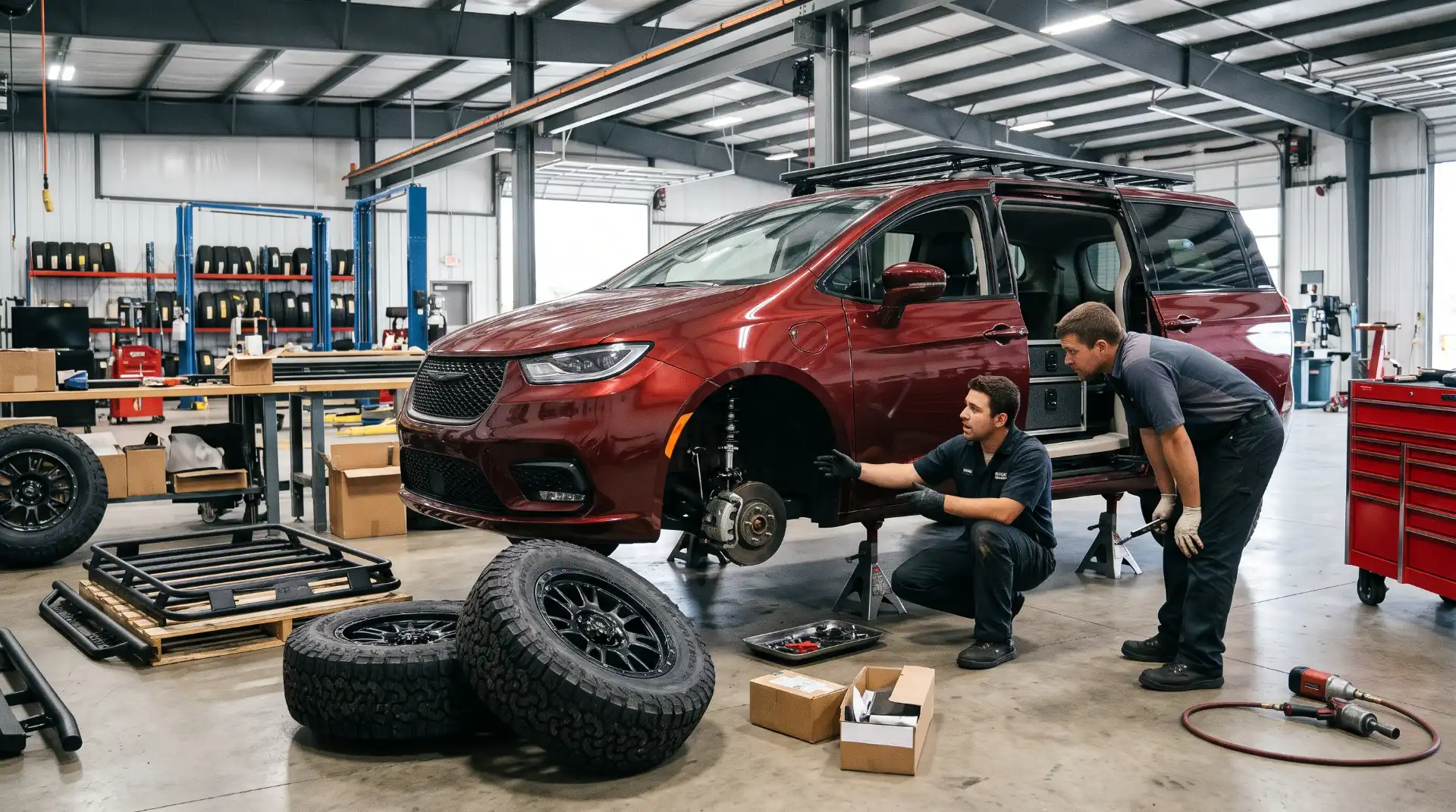
Some enthusiasts consider suspension changes to improve appearance, ride characteristics, or ground clearance.
However, modifications must be compatible with the vehicle’s original engineering.
An inappropriate suspension setup can affect alignment, steering geometry, braking behavior, stability, and tire wear.
Raising a vehicle also changes its center of gravity and can influence how it responds to sudden maneuvers.
A qualified suspension specialist should evaluate the vehicle before any major modification.
All-Terrain Tires and Traction
Tire selection can influence how a vehicle performs on gravel, wet grass, dirt roads, and other surfaces.
However, an aggressive tire is not automatically better for every adventure build.
Noise, rolling resistance, wet-road performance, braking, load capacity, and fuel economy should all be considered.
For a family minivan that spends most of its time on highways, a quality touring or crossover-oriented tire may be a better choice than an aggressive off-road design.
Choosing Appropriate Routes
A customized minivan can be useful for reaching many campgrounds, trailheads, scenic overlooks, and recreational areas.
It should not be expected to navigate every obstacle that a specialized four-wheel-drive truck can handle.
Deep mud, large rocks, steep uneven trails, deep snow, and severe ruts can create situations where a passenger minivan becomes stuck or damaged.
A sensible adventure build is designed around realistic destinations rather than extreme social-media demonstrations.
8. Customizing Different American Minivan Models
The American minivan market offers several platforms, each with its own advantages and limitations.
The best vehicle for a particular conversion depends on budget, seating requirements, mechanical condition, cargo capacity, available accessories, and personal preferences.
Chrysler Pacifica
The Chrysler Pacifica has become an especially interesting platform for enthusiast-oriented customization.
Its flexible cabin, available all-wheel drive on selected configurations, and recognizable exterior design make it attractive to families interested in combining everyday comfort with a personalized appearance.
The Pacifica’s Stow ‘n Go seating system on eligible configurations can provide useful interior flexibility, although owners should verify the specific model’s seating arrangement before planning a conversion.
The 2026 Chrysler customization concepts are particularly relevant because they show two different directions for the same basic vehicle.
One emphasizes subtle factory-inspired styling, while the VANkulture collaboration demonstrates a more ambitious enthusiast approach involving custom exterior components and chassis modifications.
This shows that minivan customization does not have to follow a single formula.
Toyota Sienna
The Toyota Sienna is another popular platform for family-oriented adventure builds.
Its hybrid powertrain and available all-wheel-drive configurations make it interesting to buyers who prioritize efficiency and practical everyday transportation.
Some owners may prefer a simple conversion focused on sleeping arrangements, portable storage, and outdoor equipment rather than extensive mechanical upgrades.
Because hybrid systems involve specialized high-voltage components, modifications around those systems should be left to appropriately qualified technicians.
Honda Odyssey
The Honda Odyssey has a long-standing reputation for family transportation and interior versatility.
Its wide sliding doors, comfortable passenger cabin, and flexible cargo arrangements make it a useful platform for weekend adventure projects.
Owners who want to preserve the vehicle’s original passenger capacity may benefit from removable camping equipment and modular storage rather than permanent seating alterations.
Kia Carnival
The Kia Carnival offers a different design direction, with styling that combines traditional minivan functionality and an SUV-inspired appearance.
Its interior space and modern equipment can support a variety of customization ideas.
Depending on the model and configuration, owners may consider exterior styling packages, protective accessories, cargo organization, and portable camping equipment.
Before selecting any of these vehicles, buyers should examine the specific model year and trim. Seating mechanisms, electrical equipment, roof-load ratings, dimensions, and available drivetrain configurations can differ substantially.
9. Full-Size American Vans Are Expanding the Adventure-Build Market
Although minivans are attracting attention, full-size passenger and cargo vans remain important to the American adventure-vehicle movement.
Vehicles such as the Ford Transit, Ram ProMaster, and Mercedes-Benz Sprinter provide substantially more interior volume than conventional minivans.
This makes them suitable for more extensive conversions.
A full-size van may accommodate a fixed bed, kitchen modules, larger electrical systems, dedicated storage, and additional equipment.
Some conversions are designed for weekend recreation, while others support extended travel or full-time van living.
The difference is that a full-size van often requires a larger initial investment and more extensive planning.
The vehicle may also be harder to park, more expensive to maintain, and less convenient for ordinary family transportation.
For some owners, a minivan is therefore the more attractive compromise.
It may not provide standing-height interior space, but it can be easier to use in cities, parking structures, residential neighborhoods, and everyday traffic.
This distinction helps explain why the customization movement is developing in multiple directions rather than converging on one ideal adventure vehicle.
10. The Growing Influence of Minivan Enthusiast Communities
Automotive customization has always benefited from communities that share ideas, photographs, technical advice, and project experiences.
Traditional car clubs helped popularize hot rods, muscle cars, lowriders, and classic restorations. Modern online communities have expanded that culture to include vehicles that were once overlooked by mainstream enthusiasts.
Minivan owners can now find inspiration through enthusiast groups, automotive forums, social media, local meetups, and customization events.
These communities are important because they demonstrate what is possible with vehicles that manufacturers originally designed for ordinary family transportation.
The VANkulture collaboration with Chrysler is a useful example of this development. Instead of treating minivans exclusively as practical passenger vehicles, the project connects them with a community that appreciates their customization potential.
The movement also challenges traditional assumptions about automotive enthusiasm.
A customized vehicle does not have to be a sports car, a pickup truck, or an expensive European performance model.
A minivan with carefully selected wheels, a distinctive wrap, an organized camping interior, and a thoughtfully designed storage system can be just as interesting from a design perspective.
Social media also helps smaller customization projects attract attention. A modest weekend conversion can inspire another owner who may not have the budget or interest for a complete professional build.
This creates a more accessible form of automotive creativity.
11. Custom Interior Design: Turning a Functional Cabin Into a Personal Space
Adventure-vehicle customization is not only about mechanical upgrades. Interior design has become one of the most important ways owners can make their vehicles feel different from ordinary factory models.
A minivan interior has to serve several purposes. It may be a family passenger compartment during the week, a cargo area for sporting equipment on weekends, and a temporary sleeping space during road trips.
That creates an interesting design challenge. The interior needs to look attractive without becoming difficult to clean, uncomfortable, or impractical.
Choosing Materials That Can Handle Family Life
Material selection should begin with durability.
Families traveling with children, pets, camping equipment, and outdoor clothing need surfaces that can withstand dirt, moisture, frequent use, and occasional spills.
Durable upholstery, washable floor protection, rubberized cargo mats, and removable seat covers can help protect the original interior.
Some owners may prefer a premium appearance using textured fabrics, leather-like materials, contrasting stitching, or carefully selected decorative trim.
Others may prefer a more rugged aesthetic inspired by outdoor equipment and traditional utility vehicles.
The best approach is to combine materials that look attractive with surfaces that can be maintained easily.
For additional inspiration on how comfort and visual design can work together, Cars-Art.com has previously explored how cozy interiors and personalization trends are redefining automotive art.
The same principles can be applied to adventure minivans. An attractive cabin does not have to sacrifice functionality.
Creating a Consistent Interior Theme
A successful custom interior usually has a recognizable design language.
For example, a family could choose a warm outdoor-inspired theme featuring dark green upholstery accents, natural-looking wood finishes, charcoal storage containers, and soft interior lighting.
Another build might use a modern minimalist approach with black materials, subtle metallic details, and carefully organized storage compartments.
The important thing is consistency.
If every component has a different color, texture, and design direction, the interior can quickly become visually confusing.
A good design should feel intentional from the front seats to the rear cargo area.
Custom Artwork and Interior Details
Automotive art can also contribute to the interior design.
Small illustrated panels, personalized storage labels, custom graphics, embroidered details, and decorative trim can give a vehicle a recognizable identity.
Owners who want a more artistic approach can explore the ideas discussed in Cars-Art.com’s guide to custom car artwork and vehicle personalization.
For an adventure minivan, the artwork could reference national parks, mountain landscapes, outdoor hobbies, vintage travel graphics, or the owner’s favorite destinations.
These details can help distinguish a vehicle without requiring extensive bodywork.
The most successful designs are usually those that complement the original vehicle rather than overwhelm it.
12. Family-Friendly Adventure Features That Make a Real Difference
A vehicle intended for family adventures needs more than attractive styling.
It must also provide convenient access to essential equipment, protect passengers, and support the different needs of adults and children.
This is where the practical advantages of minivans become particularly important.
Storage for Outdoor Sports Equipment
Families involved in cycling, fishing, hiking, skiing, photography, and other outdoor activities often struggle with equipment storage.
A minivan can be adapted with organized cargo systems that make it easier to transport this equipment.
Bicycles can be carried using an appropriately rated hitch-mounted rack or another compatible carrier. Fishing equipment can be stored in dedicated protective cases. Camping supplies can be organized in removable containers.
The important consideration is ensuring that equipment does not interfere with passenger seating, visibility, or access to emergency supplies.
Window Shades and Privacy
Window shades can improve comfort during overnight trips and help reduce unwanted sunlight.
Some products are designed specifically for individual vehicle windows, while others use adjustable or removable mounting systems.
A family planning to sleep inside a minivan should pay attention to ventilation and condensation.
A vehicle that is closed overnight can become uncomfortable as occupants release moisture through breathing. Appropriate ventilation is therefore an important part of any sleeping arrangement.
Owners should also consider privacy without compromising driver visibility when the vehicle is being operated.
Portable Refrigeration and Food Storage
Food storage is another consideration for extended road trips.
A compact portable refrigerator can be useful for families who travel frequently or want to keep certain foods cool during longer journeys.
However, refrigeration equipment consumes electricity and needs adequate ventilation.
For occasional weekend trips, a high-quality insulated cooler may be more practical.
The choice should reflect the frequency of use, available power, cargo capacity, and budget.
Entertainment and Connectivity
Modern families often travel with several connected devices.
Phones, tablets, cameras, portable gaming systems, and laptops can create additional demands on charging equipment.
A well-planned adventure minivan may include dedicated device-storage compartments, charging cables, portable battery packs, and a reliable connectivity arrangement.
These features can make long journeys more convenient, especially when children are traveling.
However, electronic equipment should never distract the driver. Entertainment systems should be arranged so passengers can use them without interfering with vehicle controls or the driver’s attention.
13. Safety Considerations When Customizing a Family Minivan
Safety should be one of the first considerations in every adventure-vehicle project.
This is particularly important for minivans because they frequently carry multiple passengers, including children.
A modification that appears harmless in a parked vehicle may create a serious problem during sudden braking or a collision.
Never Compromise Original Seating and Restraint Systems
Seat belts, airbags, head restraints, and child safety equipment should remain fully functional.
Owners should avoid installing furniture or storage structures that interfere with these systems.
The National Highway Traffic Safety Administration explains that airbags are designed to work together with seat belts, not replace them. Its guidance also emphasizes that children under 13 should ride in the back seat.
For this reason, permanent interior conversions should never be designed around the assumption that passenger safety equipment can simply be relocated or removed.
Read the official NHTSA airbag safety guidance before planning modifications that could affect passenger protection.
Secure Every Item Inside the Vehicle
Loose equipment can move violently during a crash or emergency stop.
This includes portable refrigerators, storage containers, tools, cooking equipment, batteries, and camping accessories.
Every substantial item should be properly restrained using a mounting method appropriate for the vehicle and the equipment.
A storage drawer that slides around the cargo area is not safe simply because it is heavy.
Similarly, a wooden sleeping platform should not be assumed to be secure just because it fits tightly between the interior panels.
Understand Vehicle Payload Limits
Payload is one of the most commonly overlooked considerations in adventure builds.
A vehicle’s payload capacity must account for passengers, luggage, modifications, accessories, and other carried equipment.
Consider a family of four traveling with a roof box, camping supplies, a portable power station, bicycles, and additional water containers.
Each item contributes to the total load.
Owners should consult the vehicle’s certification label, owner’s manual, and manufacturer guidance to understand the applicable weight limits.
They should also consider the weight ratings of the tires, wheels, roof equipment, and any towing accessories.
Adding accessories without considering total vehicle weight can undermine the purpose of the conversion.
Check State Requirements and Insurance
Vehicle modification requirements vary across the United States.
Depending on the modification, owners may need to consider state equipment rules, lighting requirements, registration classifications, inspection requirements, and insurance conditions.
An insurer should be informed about significant permanent modifications, particularly custom interiors, electrical systems, suspension changes, and expensive equipment.
Owners should keep receipts, installation records, product documentation, and photographs of the completed work.
This documentation can help establish the value of the modifications and clarify what is covered by an insurance policy.
14. Planning a Minivan Adventure Build on a Realistic Budget
One of the reasons minivan customization is attracting attention is that owners can approach the project gradually.
A full recreational vehicle conversion can involve substantial expenses, but a family does not necessarily need a professional camper build to make a minivan more useful for outdoor activities.
The first step is to decide how the vehicle will be used.
A family that camps twice a year has different requirements from someone who regularly takes long-distance road trips.
Entry-Level Builds
An entry-level project might focus on relatively simple additions.
These could include removable cargo organizers, protective floor coverings, a portable power station, a suitable roof storage system, and a basic sleeping arrangement.
The advantage is that owners can improve functionality without permanently changing the vehicle.
This is also an effective way to determine which equipment is genuinely useful before spending money on more advanced modifications.
Mid-Level Builds
A more developed conversion may include a professionally designed removable sleeping platform, custom storage drawers, upgraded wheels, protective exterior accessories, window coverings, and improved interior lighting.
This level of customization requires more careful planning because the combined weight and installation requirements become more significant.
Owners should also consider how quickly the vehicle can be returned to its original passenger configuration.
Advanced Builds
Advanced projects may include custom suspension components, professionally installed electrical systems, specialized exterior equipment, custom upholstery, and more extensive interior conversions.
At this level, the vehicle should be evaluated as a complete system.
It is not enough to select individual parts based on appearance. Each modification must work with the vehicle’s original engineering, electrical system, payload capacity, and intended use.
A professional conversion specialist can help evaluate compatibility before major money is spent.
Why a Gradual Approach Often Makes Sense
Many owners make the mistake of purchasing accessories before developing a clear plan.
They may buy a roof rack, storage box, lighting system, wheels, and camping equipment without considering how these components work together.
The result can be an expensive collection of parts that does not create a coherent vehicle.
A better approach is to start with the most important requirements and expand the build over time.
For example, a family might begin with a cargo organization system, then add a removable sleeping platform after testing the available space. Later, they may decide whether a portable power system is necessary.
This approach makes it easier to control costs and avoid unnecessary modifications.
15. Taking a Customized Minivan on American Road Trips
The United States offers an enormous variety of destinations for adventure minivans.
From coastal highways and mountain communities to national parks, desert landscapes, forest campgrounds, and lakeside recreation areas, families have many opportunities to use a practical adventure build.
However, road-trip planning should account for the vehicle’s actual capabilities.
A minivan may be suitable for reaching an established campground on a maintained road, but that does not mean it is appropriate for every remote access route.
National Park Adventures
National parks provide excellent opportunities for families who enjoy photography, sightseeing, hiking, and camping.
A customized minivan can carry the necessary equipment while providing comfortable transportation between destinations.
Families should research campground access, parking restrictions, road conditions, vehicle height limitations, and available facilities before departure.
The National Park Service’s camping preparation guidance recommends planning around the environment, season, activity difficulty, duration, and group capabilities.
It also recommends leaving an itinerary with an emergency contact and preparing for unexpected changes.
These recommendations are particularly useful for families traveling with children.
Coastal and Mountain Road Trips
A minivan adventure build can also be useful for coastal travel.
Families may use the vehicle to carry beach equipment, bicycles, picnic supplies, and photography gear.
Mountain road trips offer a different set of considerations. Weather, elevation, steep grades, and changing road surfaces can affect travel conditions.
Drivers should check weather forecasts, tire condition, road restrictions, and vehicle operating requirements before departing.
Camping Without Full-Time Van Life
Not every adventure vehicle needs to support permanent living.
In fact, occasional recreational use may be the most sensible purpose for many family minivan conversions.
A removable sleeping system, organized storage, and portable camping equipment can support weekend travel without permanently changing the vehicle.
This is an important distinction because it allows families to enjoy some advantages of camper-van travel while keeping their original vehicle useful for daily life.
16. The Automotive Art Opportunity Behind the Adventure Van Movement
The growing interest in van and minivan customization also creates opportunities for automotive artists and designers.
Historically, many automotive artwork projects focused on sports cars, muscle cars, exotic vehicles, motorcycles, and classic automobiles.
Adventure vans offer a different creative opportunity.
Their large side panels, broad rear sections, and relatively simple body shapes can provide interesting surfaces for original artwork.
Designers can create graphics inspired by mountain ranges, national parks, road-trip maps, vintage outdoor advertisements, wildlife, or motorsport themes.
The result does not have to look like a conventional camper van.
A minivan could feature a subtle vintage travel graphic, a modern geometric design, or a detailed illustration that connects the vehicle with a particular hobby.
Nature-Inspired Automotive Graphics
Nature-inspired designs are especially appropriate for adventure vehicles.
A wrap could feature an abstract mountain landscape, forest silhouettes, desert colors, or a coastal illustration.
These designs can create a visual connection between the vehicle and the places its owner enjoys visiting.
For a more understated look, graphics can be limited to selected panels rather than covering the entire vehicle.
Retro Outdoor Graphics
Vintage travel graphics are another interesting direction.
The visual language of older national park posters, historic road-trip advertisements, and classic recreational vehicles can be adapted into contemporary automotive artwork.
A carefully developed design might combine traditional typography, muted colors, and simplified landscape illustrations.
This style can give a modern minivan a distinctive personality without making it look excessively modified.
Photography and Show-Quality Presentation
Adventure minivans can also become interesting subjects for automotive photography.
A professionally customized vehicle photographed at a scenic campground, mountain overlook, or coastal location can communicate both its appearance and intended purpose.
Lighting, composition, background selection, and vehicle positioning can make a major difference.
For Cars-Art.com, this creates a useful editorial opportunity: automotive customization can be discussed not only as a technical activity but also as a creative process.
A family adventure vehicle can be designed, photographed, illustrated, and presented as an expression of its owner’s interests.
17. What the Future Holds for American Van and Minivan Customization
The future of van customization is likely to involve more flexible designs, improved equipment, and a stronger connection between automotive styling and outdoor recreation.
One important direction is the development of modular conversion products. As more owners look for vehicles that can serve multiple purposes, removable and adjustable systems may become increasingly attractive.
Instead of purchasing a dedicated camper van, some families may prefer to customize an existing passenger vehicle with equipment that can be installed only when needed.
Another development is the growing relationship between manufacturers and enthusiast communities. Chrysler’s 2026 Pacifica concepts illustrate how an automaker can use customized vehicles to demonstrate possibilities that extend beyond conventional factory configurations.
This could encourage more aftermarket companies to develop products specifically for minivans rather than concentrating almost exclusively on trucks, SUVs, and full-size cargo vans.
There are also opportunities in lightweight materials, compact electrical systems, improved storage designs, protective exterior products, and vehicle-specific camping accessories.
From an artistic perspective, the movement could introduce new forms of automotive expression. Custom graphics, original wraps, personalized interiors, and carefully designed exterior packages can make family vehicles more recognizable.
However, the most successful builds will probably remain those that balance appearance with practicality.
An adventure minivan should still be comfortable on a long highway journey, convenient in a crowded parking lot, and suitable for transporting passengers.
The goal is not to eliminate everything that makes a minivan useful. It is to expand those capabilities.
Conclusion: The Family Minivan Is Becoming a New Automotive Customization Platform
The American van and minivan customization movement demonstrates how automotive culture continues to evolve.
Vehicles that were traditionally associated with ordinary family transportation are finding new identities through personalized styling, modular interiors, adventure equipment, and enthusiast-oriented modifications.
A minivan can now be much more than a school-run vehicle. With the right design, it can become a weekend camping platform, a recreational sports transporter, a road-trip companion, or a distinctive example of automotive personalization.
The movement also challenges the assumption that adventure vehicles must be large, expensive, or heavily modified. Many families can create useful adventure builds through relatively simple improvements that preserve their vehicle’s original purpose.
The most important considerations remain safety, weight management, mechanical compatibility, and realistic expectations about what a minivan can accomplish.
A thoughtfully customized vehicle should improve the owner’s experience without compromising passenger protection or everyday reliability.
For automotive artists, designers, and customization enthusiasts, this movement creates another opportunity to explore the relationship between transportation and personal expression.
The modern American family vehicle is becoming a new kind of automotive canvas. Whether through custom graphics, carefully selected wheels, practical interior conversions, or creative exterior styling, owners are demonstrating that everyday transportation can also reflect individuality and adventure.
The next interesting custom vehicle at a local car meet might not be a supercar or a lifted pickup. It might be a family minivan transformed into something entirely unexpected.
And that is precisely what makes this new movement worth watching.